


And if I’m lucky enough, I will wake up a little bit hungover on a Sunday morning in 2046 and the birds will still be chirping outside of my window.
Not because they installed speakers blasting artificial birdsong playlists to drown out the constant hum of the neighborhood data centers, but because the city itself has become a habitat again.
I open the windows of my apartment and breathe in crisp morning air that smells like a mix of wildflowers and freshly baked bread from the cooperative bakery downstairs. Children are already giggling and frolicking in the car-free streets below while their parents drink flat whites together under vibrant fruit trees we’ve planted years before.
No one tells the children to be extra careful every five seconds. No one spends their life rushing somewhere they don't want to be anymore. All because ten years ago, we finally started designing cities around the flourishing of humans and nature. We finally decided to stop obsessively asking how cities could generate more economic growth and started working towards how they could help people live better lives.
I leave my home without my phone in my hand. Crazy idea? Not so much. There isn't any reason to. Technology finally learned its place as a submissive servant of humanity. It handles the things that should be effortless, then disappears into the background, which is all thanks to the collapse of Meta following the landmark lawsuit in the early 2030s. Yeah, a lot of influencers started creating fundraisers, but it didn't collapse the economy. For the first time, governments agreed that human attention wasn't an unlimited natural resource to be extracted. By doing so, the attention economy was regulated much like pollution had been decades earlier.
We still have the technology we love, but we've built a circular economy where yesterday's electronics become tomorrow's devices, making child labor in mining obsolete. These devices also no longer behave like parasites on our lives, as we really only use them to coordinate neighborhood projects, access a variety of knowledge, stay connected with the people we love and brag about our compost. Oh, and somehow Hinge is still around. Don't ask me why.
The habit of taking my phone has been happily replaced by the habit of always carrying a bunch of books with me. After the literacy crisis in 2026 was finally labeled as a threat to democracy, exchanging literature has become somewhat of a cultural obsession. You’d occasionally see a man pushing ounces of bell hooks literature in a pram - which, to be fair, is a bit weird, but this has become somewhat the equivalent of flexing the newest iPhone.
I hop on my bicycle and pedal through streets lined with edible gardens, community workshops, buildings draped in vines and neighbors vividly chatting with each other. It's practically impossible to step outside without ending up in a conversation. I still remember that we used to think loneliness was a mental health crisis, but after a council of indigenous women took on this topic, they found it was actually an urban planning crisis. The biggest surprise however was the so-called male loneliness epidemic. Despite fierce backlash from feminists insisting it was entirely self-inflicted, the council argued that no society benefits from abandoning people to isolation. Men suffering under a weird sense of superiority are now offered rehabilitation instead of podcast appearances. Talking about podcasts, male podcast were also labelled as a threat to women’s rights years ago, and therefore only allowed under strict supervision.
As I pedal on, I gaze at rooftops that now generate more energy than the entire neighborhood consumes. Every building gives back more than it takes. Rainwater disappears into gardens instead of sewers. Vines crawl up former office blocks, cooling the streets by several degrees. Air conditioning has become something people vaguely remember their parents arguing about. The loudest sound is the live music of artists who made it their mission to turn each corner of the city into a scene of LaLaLand.
At the local market, I recognize most of the people selling the food because we all helped grow it. I take a bunch of strawberries that actually taste like strawberries and tomatoes that didn’t travel across continents to reach my plate. Around noon, I walk across the street to the public kitchen where lunch is prepared collectively every Sunday. Domestic labor being a private issue, disproportionally carried by women, feels so 2026. Nobody has to cook alone unless they genuinely enjoy it and sure as hell nobody calls it “women’s work” anymore.
On the way home I pass a memorial dedicated not to male colonizers (which is a crime now), but to caregivers - mothers, grandparents, nurses, teachers, neighbors, midwifes and community organizers whose invisible labor held societies together long before governments learned how to value it.
I giggle a little at the memory of a time, just twenty years ago, when I started writing a newsletter called Futurelicious about designing a better future. Back then, people called me naïve for believing humanity deserved better than what we had. They told me politics would never change. That our body isn’t made up of 60% water, but 60% hyper-individualism, 30% convenience and 10% anxiety. That that’s just how it is. I still remember how lonely that felt sometimes, and how, on the other side, I pulled so much strength from the exact thing they were trying to take away from us - our humanity.
I feel a delicious breeze while gazing over the city one last time before closing the windows for the evening.
The rooftops are glowing softly beneath the setting sun. Somewhere, laughter echoes through the streets. A tram glides by almost silently, covered in climbing plants. A group of children race each other home through the park, their voices carried on the warm summer air.
I cuddle up beneath the soft cotton sheets of my bed, my body wrapped in their warmth and my mind wrapped in the comfort by the knowledge that we are here because countless people around the world chose to plant trees whose shade they knew they might never sit under.
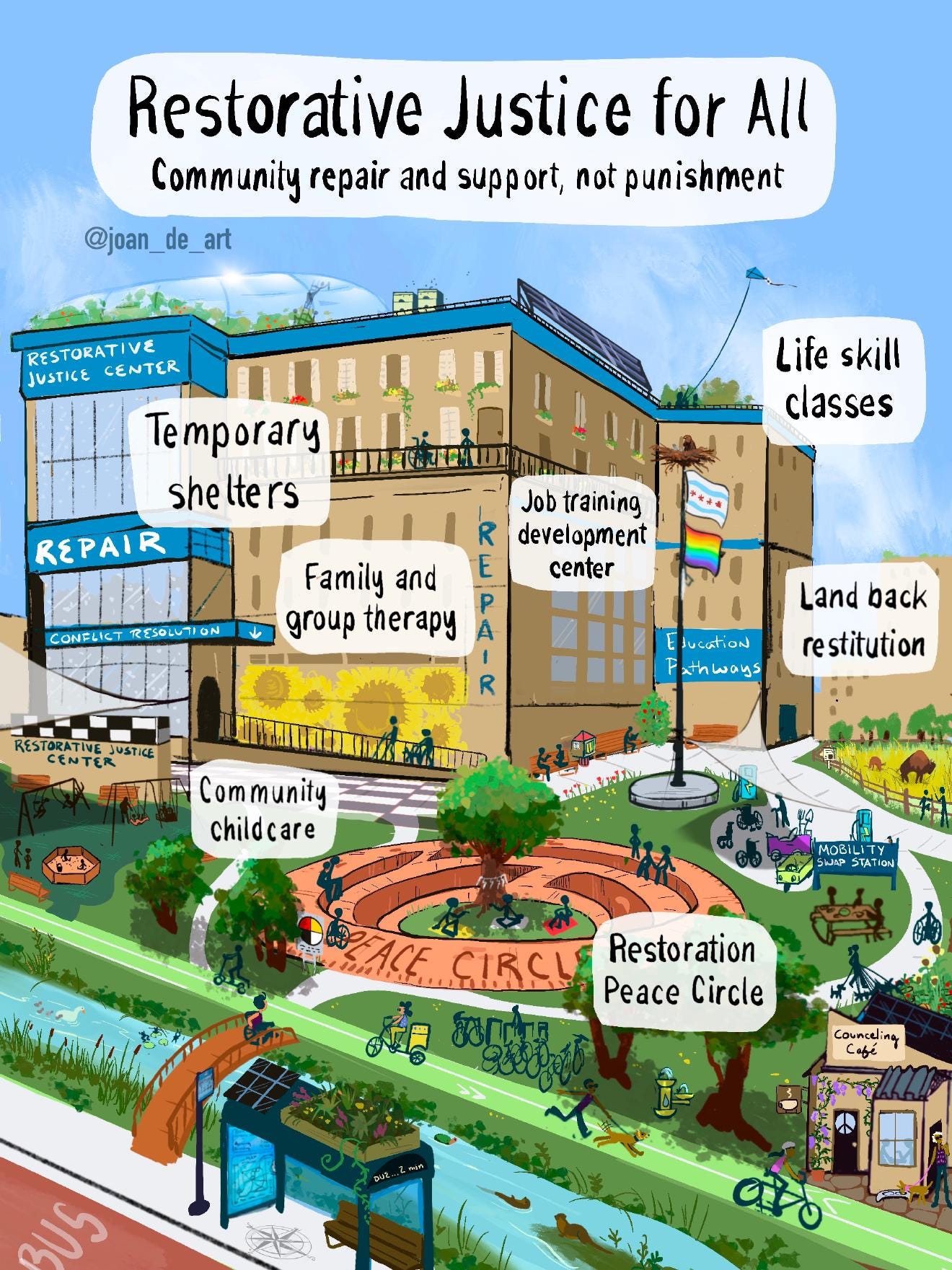
According to Solarpunk Magazine, Solarpunk is ‘a prefigurative, utopian artistic movement that envisions what the future might look like if humanity solved major modern challenges like climate change and created more sustainable and balanced societies. As a genre and cultural aesthetic, it encompasses literature, visual art, fashion, video games, architecture, and more. Solarpunk carries many aspects of punk ideologies such as counterculture, humanitarianism, egalitarianism, animal rights, decolonization, anti-racism, anti-sexism, anti-authoritarianism, anti-corporatism, and anti-consumerism. The greatest difference between solarpunk and its sister genre, cyberpunk, is that solarpunk observes harmony between nature and technology.’
Every fibre of my being wants this version of our future. I’ve recently been thinking about nature vandalism and sprinkling wildflower seeds along the sides of the footpath that I take to walk home every day. Thinking of that and reading this gives me so much hope when it all feels so bleak x
I really enjoyed this vision of the future. It feels optimistic without ignoring today's problems, and all the little everyday details made the world feel genuinely lived in rather than just idealized.
I'm curious was there one specific Solarpunk idea that inspired this piece, or did the vision come together from lots of different influences over time?